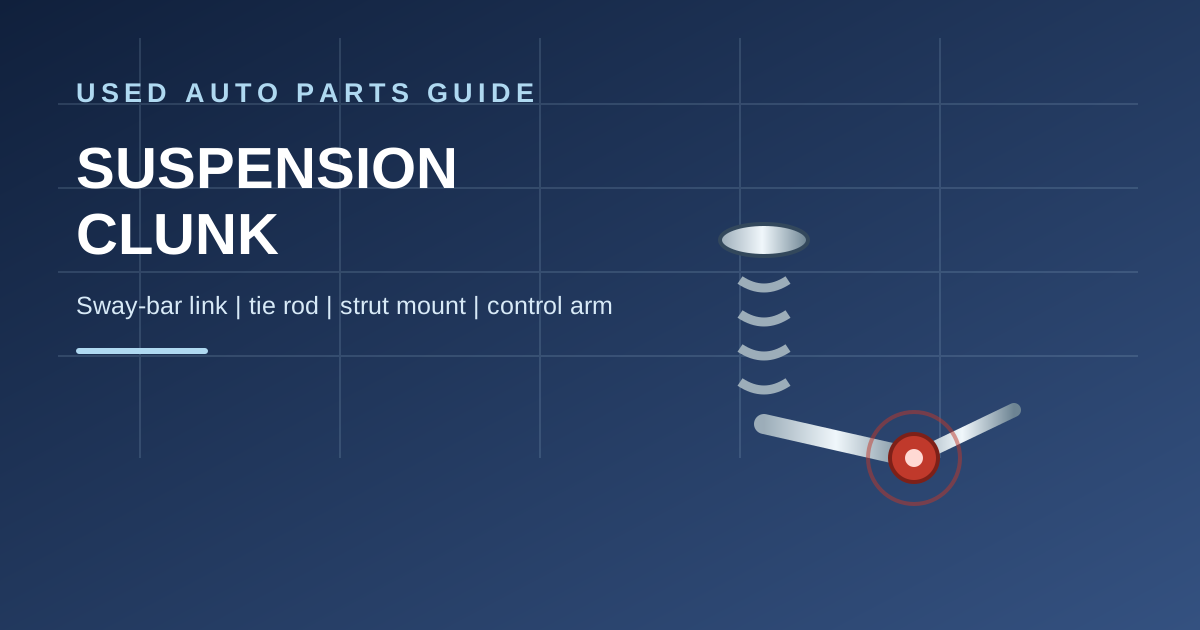
You go over the same expansion joint every morning and the car answers with a single knock from one front corner. Nothing on the dash, nothing wrong in the steering. A clunk over bumps is one of the most misdiagnosed noises on a car, and two of its common causes are small enough that nobody suspects them. Here is how to narrow it down before you order anything.
When it happens matters more than what it sounds like
Everyone describes a clunk differently, so the description alone settles nothing. The trigger does. Spend a few days noting four things:
- Trigger: bumps only, or also turning, braking, pulling away, or shifting between drive and reverse?
- Speed: worst crawling over broken pavement and driveway aprons, or only at road speed?
- Corner: which wheel, and is it one corner or both?
- Company it keeps: just noise, or also vague steering or a bouncy ride?
A technician will ask you these exact questions, and good answers beat a part number.
Two common causes are parts we do not broker
Better to say this up front than sell you something you did not need. Two parts commonly behind this noise are sway bar (stabilizer) end links and outer tie rod ends, and neither is in our catalog. We broker larger used assemblies — control arms, struts, shocks, hubs, subframes, steering racks — not end links, sway bar bushings, tie rod ends or standalone ball joints. If that is your noise, a parts counter is the right stop.
Sway bar end links
MOOG describes a metallic clunking or knocking sound when going over bumps or traveling at higher speeds as a sign of a bad sway bar link, often alongside a loose feel while turning and extra body roll. The links tie the sway bar to the control arms, steering knuckles or struts, so a worn one knocks every time the suspension cycles; water, road debris, heat and pothole or curb impacts finish them. Mevotech's check is a shake test at the connecting rod, plus a separate feel for play with the wheels on the ground.
Outer tie rod ends
MOOG lists a knocking or clunking sound from the front of the vehicle when turning at low speeds as a symptom of bad tie rods, with common companions of a steering wheel that shakes or feels loose and tire wear heavier on one side of the tread. These are steering parts, so the stakes differ: MOOG says the consequences of a failure run from premature tire wear to loss of vehicle control.
Strut mounts and bearing plates
The top of a strut is a wear point in its own right. Monroe's guidance for chasing a clunk after new struts are fitted gives a split worth borrowing: noise over bumps points the inspection at the upper mounting plate, noise while turning at the upper bearing assembly. Monroe also warns that a mount can look tight and still move once the car is rolling, and that mounting hardware can stretch or deform after being over-torqued or repeatedly retightened. If the mount is the problem, settle with your installer whether it is done on its own or with the strut assembly.
Control arm bushings and ball joints
MOOG attributes a clunking noise from the front over bumps, potholes or other road hazards to the bushing hitting between the frame and the control arm, and says it can also appear while accelerating, decelerating or steering. MOOG ties the same failing arm to wandering or pulling and to wear toward the inner or outer edge of the tread.
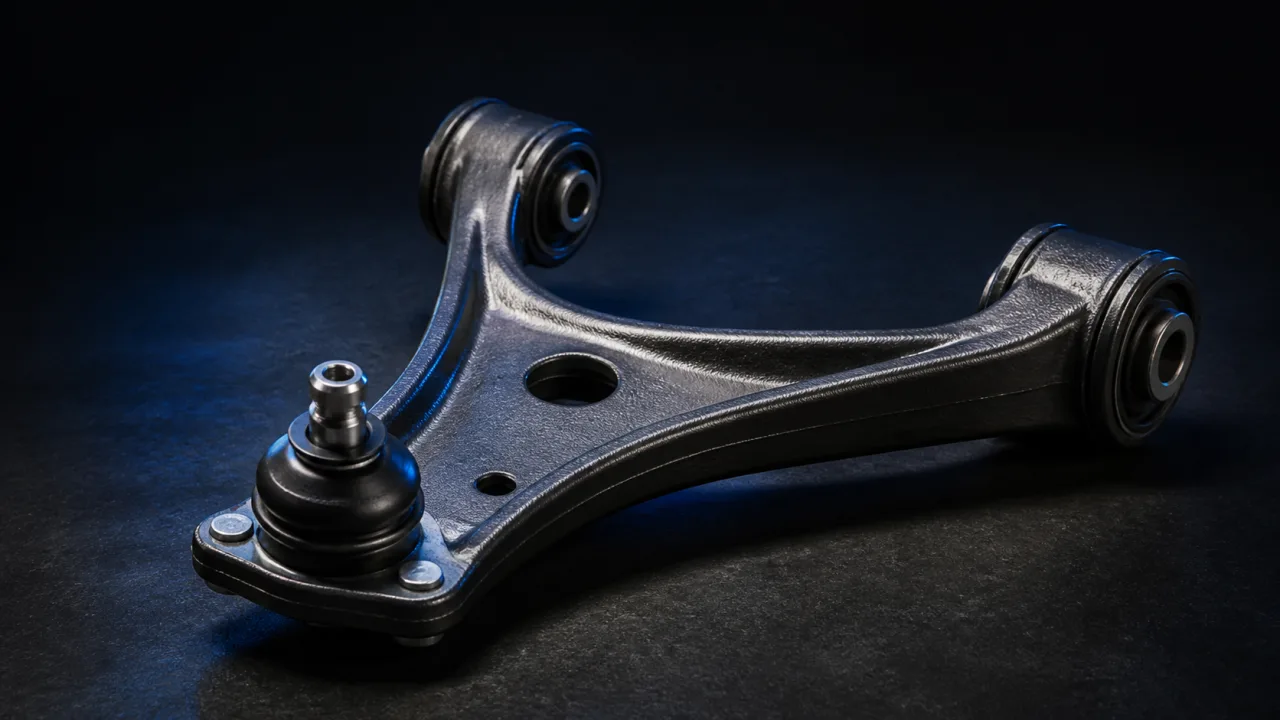
A ball joint is quieter at first. MOOG describes the first indication of a worn or loose joint as a faint, intermittent clunk from one corner, more noticeable over a bump or a dip or around a corner, growing louder and more frequent as wear continues; the car may also drift left or right over bumps. Whether a worn joint is renewed on its own or the whole arm goes depends on the vehicle — our used control arm guide covers that decision.
The shock or strut itself
A worn damper clunks too. Monroe attributes the clunking or knocking sound from worn shocks and struts to metal-to-metal contact when the unit bottoms out on a bump, with the usual companions: bouncing that will not settle, nose dive under braking, sway in turns, cupped tires. Start with the shock absorber page and our guide to buying used shocks and suspension, which explains why dampers go in axle pairs.
When it is not the suspension at all
Walker's troubleshooting list for excessive exhaust noise includes contact with the undercarriage, broken hangers and insulators, and loose joints. A system hanging on failed mounts has room to move, so it belongs on the list when the noise does not sit clearly at one corner. Heat shields are the other classic: NAPA puts their failure down to rust and vibration, with clamps, bolts or welds rusting away until the shield hangs loose.
If the noise started after suspension work, suspect the installation before the parts. Mevotech is explicit that control arm bolts must be torqued with the arm at ride height, not at full extension on the hoist: bushings tightened outside their static position get twisted and fail early.
And it is probably not the wheel bearing. Timken is precise: humming, rumbling or growling usually traces to tires, electrical or driveline parts, and only reads as a bearing when it presents in a straight line and intensifies as you turn the wheel slightly, with the side opposite the rumbling usually the bad one. Knocking or clunking is normally heard when shifting — changing direction, or accelerating to coasting — which Timken attributes to CV or U-joint play or backlash in the differential gears, not to bearings. If that pattern fits yours better, start with our guide to bad CV axle symptoms.
How a shop confirms it
This is where we hand you over, deliberately. Tie rod ends, ball joints and strut mounts are steering and load-bearing parts, and finding play in them means working under a supported vehicle. Shop work.
Knowing the method tells you whether yours actually looked. Ask whether they ran a dry park test: Mevotech calls it extremely effective at exposing loose linkages and worn bushings, because the steering is worked back and forth while a second person watches underneath for free play. It takes two people and a properly supported car, which is why it is not a driveway job. Ball joints get measured, not guessed at: Virginia's safety inspection regulation tells inspectors to use a dial indicator or ball joint checking gauge for ball joint play wherever the manufacturer provides procedures and specifications, and the same section fails broken or sagging springs, struts that are broken, bent or loose, and a control arm whose bushing lets the component move by hand.
Do not wait this one out
Not every clunk is urgent, but two of its causes are. MOOG warns that if ball joint wear becomes severe the stud may separate from the housing, resulting in immediate loss of control, and says to have the vehicle checked by a professional technician experienced with suspension diagnosis. Delphi says the same of worn steering and suspension parts generally, including loss of steering control from failed ball joints and control arms. A noise getting louder is telling you something.
Once you know which part it is
Order against a diagnosis, not a guess. Send the VIN, the corner, and the trim or suspension package: adaptive damping, load-leveling and heavy-duty packages all change the part. Returns are not normally available when a part does not fit because the VIN or vehicle details supplied to us were incorrect or incomplete.
Our 30-day limited warranty from delivery, up to 90 days on select parts where your quotation says so, covers the part itself — not labour, installation, diagnostics, towing or any other repair cost. A return is for an uninstalled part inside the 7-calendar-day window after confirmed delivery and needs a written RMA from us first; a warranty claim is a different clock, for a part that proves defective after fitting. The quotation controls.
When the shop has named the part, send your VIN with the part and corner and we will quote it.