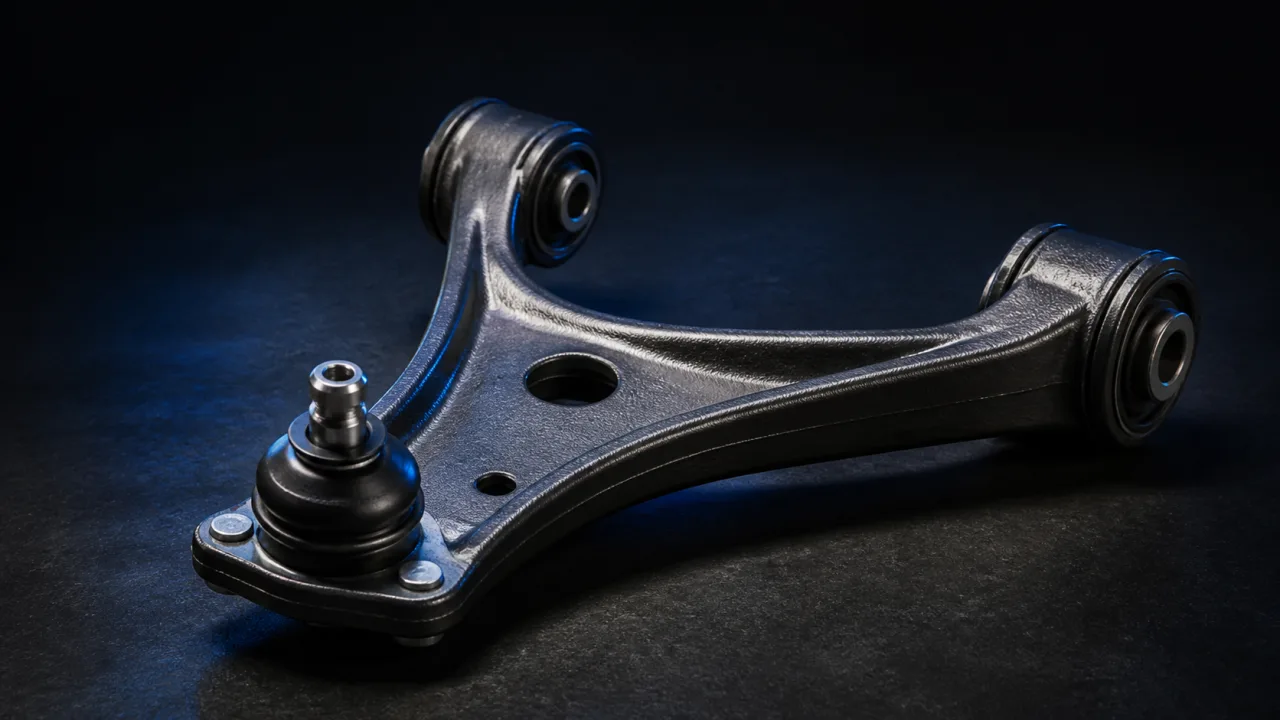
Quick answer: A control arm can fail in three places — its bushings, its ball joint, or the arm itself — and the complete arm is usually the practical unit to buy, because pressing parts out of an old arm can cost more in labor than it saves. Get the corner inspected first: a loose ball joint is a safety failure, not a noise to live with. Review control-arm fitment or get a VIN-based quote.
Control arms connect your wheel hub and suspension to the frame, locating the wheel while letting it move up and down. Their bushings and ball joints wear over time, causing noise, sloppy handling and uneven tire wear. A used control arm — ideally a complete assembly with the ball joint and bushings — is an affordable repair.
Signs of a worn control arm
- Clunking or knocking over bumps
- Loose, wandering, or vague steering
- Vibration through the steering wheel
- Uneven or rapid tire wear
- Visible cracked/torn bushings or a loose ball joint
What a used control arm costs
Used control arms are an inexpensive repair, and a complete assembly (arm + ball joint + bushings) saves the labor and special tools of pressing parts. Control arms are usually replaced in pairs (left and right) so handling stays balanced.
How to buy the right one
- Match by VIN: upper vs. lower, front vs. rear, and trim/suspension package all affect fitment — search by VIN.
- Check the ball joint and bushings for play, cracks, or tears.
- Replace in pairs for balanced handling.
- Get an alignment after installation.
Reading the symptom before you buy
A clunk or pop as you pull away or hit the brakes is characteristic of a worn bushing: the arm is no longer held firmly in its mount, so it shifts fore and aft under load. A sneakier version of the same fault: a shudder through the wheel under braking that gets blamed on warped rotors, when a worn front bushing or ball joint reproduces it exactly. If new rotors did not cure your brake shudder, have the front suspension checked before you buy more brake parts.
Confirming it is shop work. A technician levers between the arm and its chassis mount, watches for movement and cross-checks the alignment readings. Take a ball joint seriously while you wait: at worst the stud separates from the knuckle, the wheel folds under the car and steering is gone, which is why a joint with severe play should be trailered, not driven.
Bushings, ball joint, or the whole arm?
On paper, bushings alone are the cheap fix. In practice, pressing an old bushing or ball joint out and a new one in needs a hydraulic press and the right sleeves and can absorb as much shop time as fitting a complete arm — and some shops decline to press standalone ball joints at all. There is a limit to what an old arm is worth restoring: pressing new parts into eyelets in a corroded or fatigued arm can leave a loose press fit later.
That is why a complete used arm — arm, bushings and ball joint together — is often the sensible unit to quote. Tell us the vehicle and position and we will confirm whether the arm you are quoted includes the joint. If the noise turns out to be higher up, the strut guide covers mount-bearing noise, and a worn wheel hub sounds different again.
Two things that belong in the estimate
Alignment, first. A replacement arm never sits exactly where the old one did — there is tolerance in the mounting points and fasteners, and the old arm's aged bushings had shifted the settings anyway — so camber, caster and toe all move, and camber left off spec eats a tire edge. Second, how the bolts are tightened. Rubber suspension bushings must be final-torqued at ride height; done with the suspension hanging, the bushing is twisted away from its neutral point from day one, which shortens its life and can create the very clunks and creaks you just paid to fix. See how used-part pricing is built.
Find a used control arm
Review control-arm fitment or request a VIN-based quote so the correct side, configuration, condition, shipping, warranty, and final pricing can be confirmed before purchase.