Quick answer: Your 17-character VIN pins down the specs that decide fitment — body style, engine displacement and cylinders, transmission and restraint system — far more precisely than year/make/model, because those attributes are encoded in positions 4–8 of the VIN itself.
The Vehicle Identification Number (VIN) is a 17-character code unique to your car. For parts ordering it's invaluable, because it encodes the exact specifications that determine fitment.
Where to find your VIN
- Driver's side dashboard, visible through the windshield
- Driver's door jamb sticker
- Vehicle registration, title or insurance card
Which VIN position carries what
- Positions 1–3 — WMI (World Manufacturer Identifier): the maker, country of origin and vehicle type.
- Positions 4–8 — VDS (Vehicle Descriptor Section): body style, engine displacement and number of cylinders, transmission type, and the active restraint system, per each manufacturer's own table.
- Position 8 specifically: on most makes this is the engine character — but the code-to-engine map is set by each manufacturer, so it only means something read against that make's lookup, not across brands. (Our guide to reading your VIN and engine code walks through it.)
- Position 9 — check digit: a math checksum (required on North-American-market vehicles) that flags a mistyped VIN before it becomes a wrong-part order.
- Position 10 — model year.
- Position 11 — assembly plant.
- Positions 12–17 — serial number: the sequential production number unique to your specific car.
The model-year cycle (position 10)
Position 10 runs a fixed 30-year cycle: the letters A–Y (skipping I, O, Q, U and Z) followed by the digits 1–9. A = 1980 and the letters run up to Y = 2000, then 1 = 2001 through 9 = 2009 — and the cycle repeats, so A means 2010 again. Because the codes recur every 30 years, position 7 tells you which lap you're on: it's a letter on 2010-and-newer vehicles and a number on 1980–2009 ones.
Why a VIN alone isn't always enough for parts
Two cars that decode to the same VIN pattern can still take different parts. The VIN doesn't spell out every mid-year running change, the drivetrain split (2WD vs. 4WD), every trim option, or the exact build date — and suppliers frequently break a part number at a specific production date. The tiebreaker is the build label: the door-jamb and underhood stickers, and on GM vehicles the Service Parts Identification (SPID) label — the sticker in the glovebox or trunk that lists the factory RPO option codes for exactly how the car was equipped. That's why we quote on the VIN and the original part number read off the old unit: together they confirm fitment the VIN can't nail down on its own.
Decode your VIN now
Use our VIN decoder and parts finder to autofill your vehicle and request a fitment review for the exact part you need.
Frequently Asked Questions
Where is my VIN located?
Look at the driver-side dashboard through the windshield, the driver door jamb sticker, or your registration, title, or insurance card.
Why order parts by VIN instead of year, make and model?
A VIN encodes the exact engine and specifications, capturing mid-year changes and engine variants that year/make/model alone can miss — so you get the right part the first time.
Is it safe to share my VIN with a parts supplier?
Yes. A VIN identifies the vehicle specification, not personal ownership details, and is routinely used to confirm parts fitment.
Does the VIN tell me which engine my car has?
Usually. The engine is encoded in the descriptor section (positions 4–8), and on most makes position 8 is the engine character. The catch is that each manufacturer sets its own code-to-engine map, so that character only means something read against your make's lookup — which is why we confirm the engine, not just the VIN.
What year is my car from the 10th VIN character?
Position 10 follows a 30-year cycle of letters A–Y (skipping I, O, Q, U and Z) then digits 1–9: A is 1980, Y is 2000, 1 is 2001 through 9 is 2009, then it repeats (A again is 2010). Position 7 being a letter means 2010 or newer; a number means 1980–2009.
Do used auto parts have a VIN stamped on them?
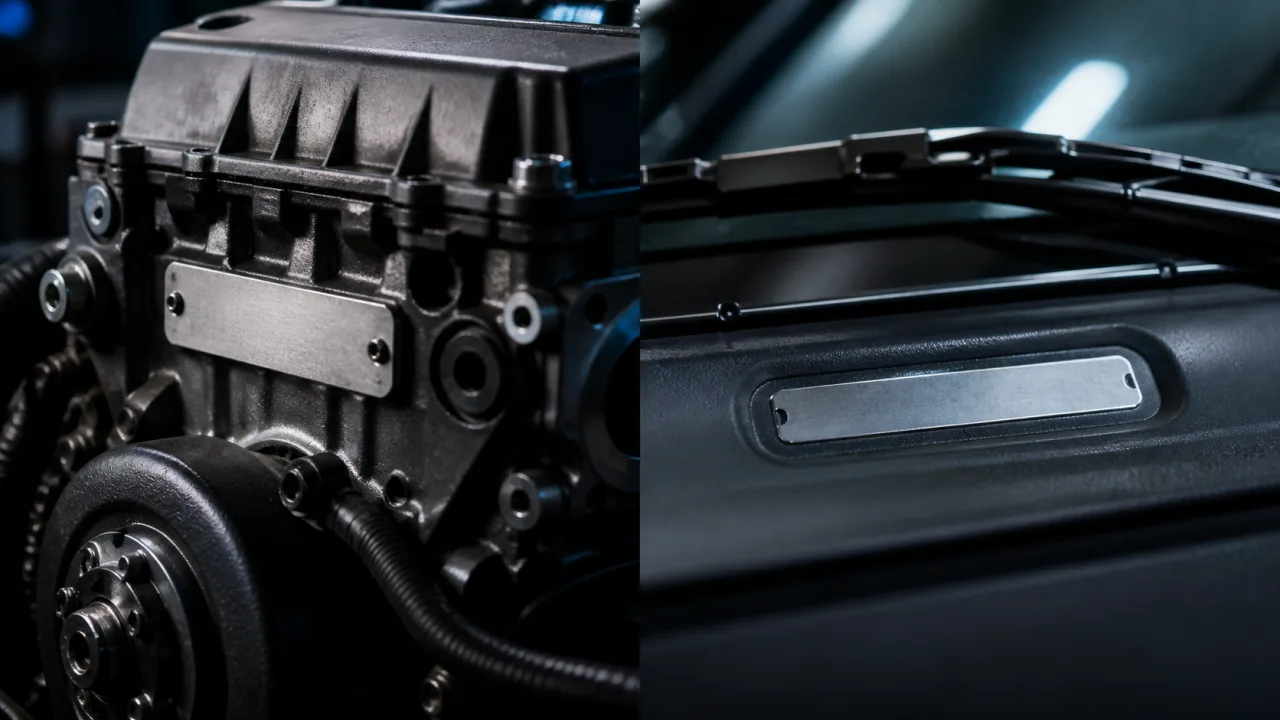
Often yes. The federal anti-theft parts-marking standard requires the VIN on major parts of covered car lines - engine, transmission, hood, both front fenders, the doors, both bumpers, rear quarter panels and the decklid, tailgate or hatch - marked so the number stays visible once the part is off the vehicle. On a salvage part that is the donor car's VIN, not yours, so it shows origin rather than fitment.
How do I find my car's exact trim or submodel to order parts?
Trim is not a VIN attribute. For passenger cars the descriptor section has to encode make, line, series, body type, engine type and the restraint system - trim level is not on that list, and NHTSA's free decoder shows only what each manufacturer reported, so what comes back varies by make. The door-jamb certification label, the window sticker and a dealer's build record are what settle it.
How do I find the OEM part number for my car?
Two routes. Unique part numbers are how a franchised dealer's parts counter identifies a part, and their catalogs use the VIN to pick the one number that fits, because a single catalog call-out can list many part numbers separated by fitment codes. The other route is the number printed, stamped or cast on the old unit itself. Send that number with your VIN on a quote request and the match gets much tighter.
What does supersession mean when a part number changes?
It means the manufacturer replaced one part number with a newer one, so the old number is no longer what you order. Catalog data tracks each number's status - current, superseded, split or discontinued - along with the full supersession trail, which is how a number read off a twenty-year-old part is followed to today's number. A superseded number is not evidence that the part you found is the wrong one.