
Quick answer: The 17-character VIN identifies the vehicle and engine content usually sits inside positions 4–8, but the standard lets each manufacturer choose which character carries which attribute — there is no universal "8th digit = engine" rule. The VIN also often says nothing about which transmission was fitted. For driveline parts, send the VIN plus a photo of the code stamped on the part itself.
The single best way to order the correct used part is by VIN, because it encodes your exact specifications — including the engine. Here's how to read it and find your engine code.
Where to find your VIN
- Driver's-side dashboard, visible through the windshield
- Driver's door jamb sticker
- Vehicle registration, title, or insurance card
What the 17 characters mean
- Positions 1–3 (WMI): manufacturer and country
- Positions 4–8 (VDS): model, body style, and — importantly — engine type
- Position 9: a check digit
- Position 10: model year
- Position 11: assembly plant
- Positions 12–17: the unique serial number
What positions 8, 9 and 10 actually do
Federal rules fix the shape of a VIN, not the meaning of every character. Within positions 4–8 the characters used "and their placement within the section may be determined by the manufacturer" — they need only be decipherable from information the manufacturer supplies. An 8th-digit engine code is a convention, not a law, so a decoding chart written for one brand misleads on another.
Two positions are fixed. Position 9 is a check digit computed from the other sixteen, so a mistyped VIN normally fails validation rather than returning the wrong car. Position 10 is the model year from a standard table — and model year is not build date. The certification label on your driver's door pillar carries the actual month and year of manufacture — that is what settles a mid-year parts change, so photograph it with the VIN.
Finding your engine code
One character within positions 4–8 identifies the engine. This is why VIN ordering is so much more accurate than year/make/model alone — two identical-looking cars can have different engines that take different parts. You can also find the engine code on a label under the hood or stamped on the engine block itself.
Reading the code on the engine itself
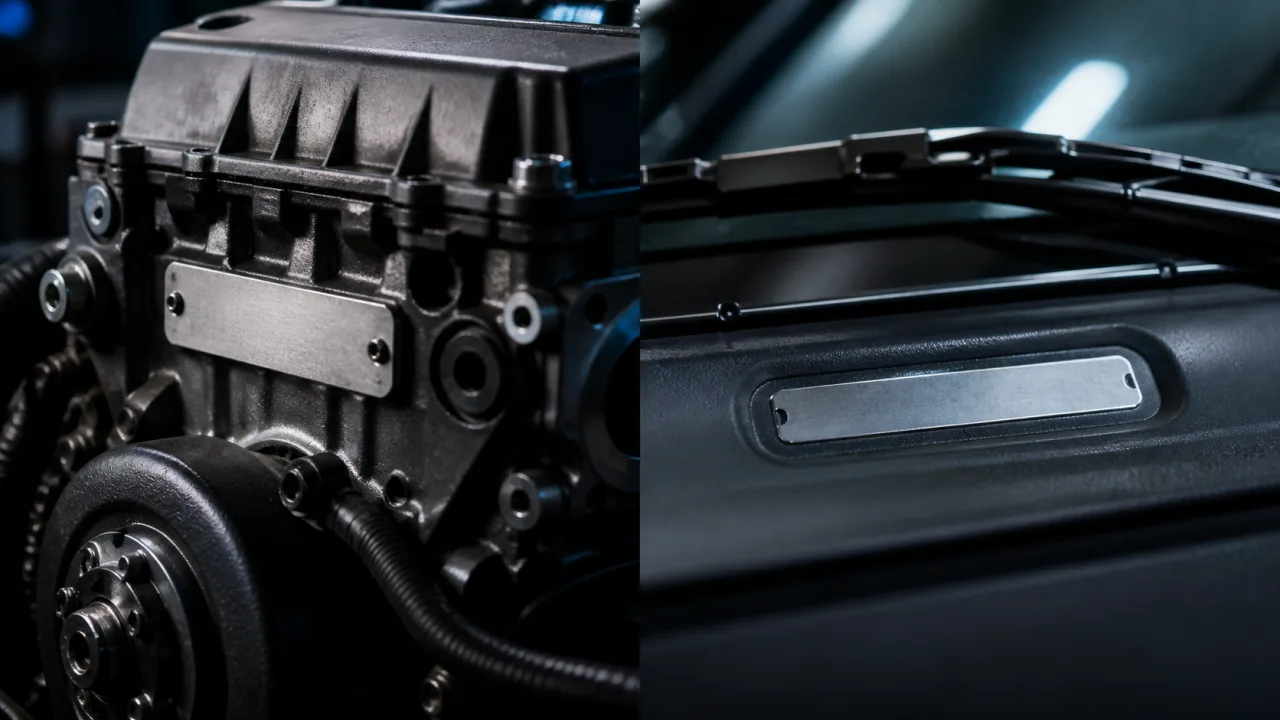
Engine identification is stamped, not cast: struck into a machined pad on the block, which is why it looks different from the raised casting numbers moulded into the metal nearby. A casting number identifies the block that was poured; the stamped ID identifies the engine that was assembled. Location varies by family; on small-block Chevrolet V8s the pad sits in front of the passenger-side cylinder head, often hidden behind the alternator.
Photograph that pad, the under-hood label and the door-jamb label and attach all three to your quote request. That prevents most wrong-part shipments on an engine or cylinder head, because the supplier can verify the unit in hand against your actual vehicle rather than trusting a decode.
Why the VIN often will not tell you your transmission
Engine content is usually recoverable from the VIN; transmission content often is not, because many manufacturers never encoded it there. General Motors, for example, publishes it as a Regular Production Option code — GM transmission RPOs begin with M — printed on the Service Parts Identification label rather than in the VIN. That label sits in the glovebox, trunk or spare-wheel area, the console or a door opening depending on model.
So for a used transmission expect to supply more than the VIN — the option code, the tag stamped on the case, and 2WD versus AWD. Our used transmission fitment guide covers the rest; differentials are worse still, since axle ratio is its own code.
Why it matters for used parts
Ordering by VIN (and confirming the engine code) dramatically reduces the chance of receiving a part that doesn't fit — meaning fewer returns and a faster repair. For more, see our guide to decoding your VIN for parts.
Decode your VIN now
Use our VIN decoder and parts finder to autofill your vehicle and get matched with the exact parts you need.


